
- Prioritize credible risk scenarios using evidence, consequences, and the protection already operating.
- Urgent protective action and permanent corrective work may follow different schedules.
- Verify treatment effectiveness before recording reduced risk or withdrawing temporary safeguards.
A distribution center has three findings: former contractor badges remain active, a delivery entrance is regularly left open, and a perimeter camera works intermittently.
Which should the security manager address first?
The answer depends on what those conditions allow, who could be affected, and what protection remains. Replacing the camera might deliver a visible improvement while leaving a more immediate access problem unresolved.
A physical security risk assessment helps managers examine those differences and explain their decisions.
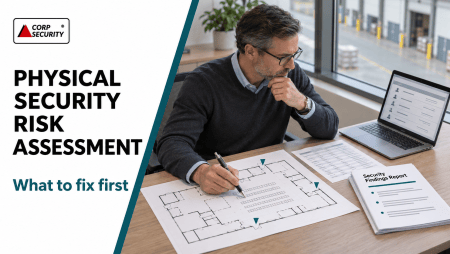
Reviewing evidence helps managers decide which security findings need attention first.
What Is a Physical Security Risk Assessment?
A physical security risk assessment evaluates how credible threats or hazards could affect people, facilities, assets, and operations. It examines vulnerabilities, existing controls, potential consequences, and uncertainty to support decisions about protection.
An inspection might establish that a door does not latch. The assessment asks what that condition could enable, under which circumstances, and with what consequences. Management then determines the appropriate response.
The output should explain exposure and treatment priorities. An equipment list alone does not establish why a particular investment deserves attention.
1. Define the Scope and Decision Criteria
Start with the business activity being protected.
For the distribution center, the scope might cover employee and contractor entry, delivery operations, and perimeter detection during occupied and unoccupied hours. Identify exclusions so that a limited review is not mistaken for an assessment of the entire site.
Agree on:
- Time horizon: The period and operating conditions being assessed.
- Protection priorities: People, restricted areas, inventory, equipment, and essential activities.
- Requirements: Applicable obligations, contracts, and organizational policies.
- Evaluation criteria: How likelihood, consequences, and acceptable exposure will be judged.
- Authority: Who recommends treatment, implements changes, and approves remaining risk.
Security may coordinate the assessment while Facilities owns door hardware and Operations manages receiving activities. The person identifying a concern may not control the process that creates it.
Include Vendor Notification Responsibilities
Contractor access also depends on information from staffing agencies, service providers, and subcontractors.
Define who reports a departure or authorization change, the notification deadline, the receiving contact, and the escalation route if acknowledgment is missing. Incorporate these expectations into applicable contracts or service procedures.
Then reconcile notifications against access records. A contractual requirement does not demonstrate that information arrives or that permissions are removed.
2. Turn Observations Into Credible Risk Scenarios
“Contractor badges remain active” describes a condition. A useful scenario explains the event that condition could enable.
Illustrative scenario: A person whose authorization has ended attempts to use a previously issued badge to enter a restricted operating area.
Separate its components:
- Threat event: Attempted entry after authorization ends.
- Vulnerability: The badge remains enabled.
- Potential consequences: Unauthorized access affecting personnel, assets, or operations.
- Evidence: Enabled permissions are documented, and the responsible business contact confirms that authorization has ended.
- Uncertainty: Attempted misuse has not been established.
An enabled badge does not establish malicious intent, an actual intrusion, or successful access through every permitted door.
Record what is verified, what is assumed, and what needs examination. This makes the assessment easier to review and challenge constructively.
3. Determine Whether Existing Controls Work
Evaluate safeguards against the scenario, rather than counting how many are installed.
For the badge finding, examine permitted areas, access schedules, identity checks, monitoring, and response arrangements. A staffed reception desk offers limited protection if the badge permits entry through a separate, unstaffed entrance.
Access logging creates a record. Unless relevant events receive review and an appropriate response, logging may provide little immediate intervention.
Use evidence suited to the control: configuration review, maintenance records, interviews, observations, or authorized testing. Plan checks to preserve safety and operational continuity.
Examine dependencies as well. Two safeguards may appear independent while relying on the same network, power supply, or response team.
Where effectiveness remains unverified, identify that limitation rather than treating the safeguard as demonstrated protection.
4. How Should Managers Prioritize Physical Security Risks?
Prioritize using credible scenarios, potential consequences, existing controls, applicable requirements, and uncertainty. Explain the reasoning behind each rating.
Likelihood judgments may draw on operating conditions, incident history, relevant threat information, and control performance. An absence of reported incidents does not prove negligible exposure, especially where detection or reporting is weak.
Use consequence criteria appropriate to the organization, including injury, operational interruption, asset loss, and restricted-information exposure.
Apply the approved rating method consistently. Multiplying categories such as “likelihood 3” and “impact 4” creates a prioritization aid; it does not establish a precise probability or financial forecast.
General frameworks such as ISO 31000 provide risk-management context. The working assessment still needs explicit criteria and documented reasoning.
Address Life-Safety Hazards Immediately
If a finding compromises emergency egress or an essential life-safety safeguard, initiate the site’s emergency escalation and protective procedures without waiting for a completed risk matrix.
Notify responsible safety, Facilities, and operational personnel. Determine whether affected activities or occupancy need restriction. Do not improvise door-locking changes or assume a temporary workaround provides equivalent protection.
For workplaces subject to OSHA’s exit-route rules, 29 CFR 1910.37 requires exit routes to remain free and unobstructed and specified emergency safeguards to remain operational. Security improvements must preserve applicable emergency-egress requirements. Routine risk acceptance cannot override a legal obligation.
Physical Security Risk Assessment Example: Three Competing Findings
Fictional example: Assume ordinary distribution operations, no confirmed intrusion, and authorized procedures for changing access permissions. All details below are invented for instruction.
| Finding | Evidence and existing safeguards | Initial management response |
|---|---|---|
| Former contractor badges remain enabled | Authorization has ended, but permissions include an unstaffed employee entrance. Misuse has not been established. | Initiate authorized verification and removal; review relevant access activity and offboarding controls. |
| Delivery entrance remains open during unloading | Repeated observations confirm the condition. A receiving employee is present, but responsibility for checking entry is unclear. | Assign temporary entry oversight and examine the receiving procedure and accessible areas. |
| Perimeter camera operates intermittently | Faults are documented. Adjacent coverage appears available, but nighttime visibility is unverified. | Arrange authorized coverage checks and fault assessment; introduce interim protection if needed. |
The Manager’s Decision
The manager initiates badge verification and removal promptly because confirmed expired authorization remains associated with an enabled entry route.
Meanwhile, the receiving supervisor establishes temporary entry oversight, and an authorized person checks camera coverage.
These actions run in parallel. Permanent corrective work receives separate priorities after the causes and remaining exposure are better understood.
The decision would change if the open delivery entrance allowed uncontrolled access to an occupied hazardous area. Discovering that the failed camera provides the only effective detection at a critical entrance could also make interim protection urgent.
This is a conditional decision, not a universal ranking of badges above doors above cameras.
5. Choose Treatment and Document Remaining Risk
Treatment may involve changing an activity, improving controls, reducing exposure, sharing specified financial consequences, or seeking authorized acceptance.
Match the response to the scenario. A replacement badge system may not fix missing departure notifications. Insurance may address some financial consequences without preventing unauthorized entry or injury.
Residual risk is the risk remaining after controls are taken into account. Distinguish current residual risk, based on existing controls, from the risk expected after proposed treatment. Approving a corrective measure does not demonstrate reduced exposure; verify effectiveness before recording the anticipated improvement as achieved.
For the badge finding, an illustrative decision record could contain:
Immediate action: Complete authorized access removal and retain relevant records.
Process treatment: Reconcile contractor departure notifications with confirmed removal.
Action owner: Security access administrator, supported by the contractor-management function.
Approval: Escalate proposed acceptance of remaining exposure to the designated risk owner.
Verification: Confirm affected permissions are disabled and examine subsequent departures for timely removal.
Review trigger: Another offboarding exception or completion of the agreed observation period.
Use actual names, deadlines, and assessment rationale in the working record. The manager recommending treatment may not have authority to accept risk for the business.
Prevent Temporary Measures From Drifting
Give interim protection an owner, defined coverage, review date, and deadline for replacement or explicit renewal. Record staffing, cost, and operational dependencies.
Reaching that deadline should trigger escalation—not automatic withdrawal of protection. Before removing the measure, verify that the permanent solution works or approve an appropriate alternative.
6. Verify Effectiveness and Reassess
Task completion and control effectiveness answer different questions.
Disabling identified badges resolves known instances. Checking subsequent contractor departures helps establish whether the process now operates reliably.
Define verification before closing the action. Depending on the safeguard, use configuration checks, authorized testing, observations across relevant shifts, or reconciliation of records.
If verification fails, revise treatment or reassess the remaining exposure.
Set reassessment triggers around changes such as new operating hours, different site activities, contractor changes, significant incidents, control failures, or relevant threat information. Follow applicable review requirements as well.
These decisions form part of the broader corporate security manager’s responsibility for coordinating protection with business operations.
Your Next Step: Improve One Existing Finding
Select one open assessment finding. Can another manager identify the scenario, evidence, existing controls, rating rationale, required decision, and verification method?
If the recommendation says only “install another camera” or “provide refresher training,” work backward. Establish the condition it must change and what would demonstrate improvement.
That turns an equipment or activity request into a recommendation the business can evaluate.
Develop Your Security Management Judgment
Prioritizing findings requires coordinating stakeholders, recommending proportionate action, and maintaining accountability for results. Explore CorpSecurity International’s CSM® Certified Security Manager certification and its published coverage of physical security management, operations management, and stakeholder management.
You must be logged in to post a comment.